
Sales cycles in home remodeling are long, unpredictable, and full of drop-off points that cost you real money. A homeowner might request a quote in January and not sign until August, if they sign at all. Meanwhile, your competitors are getting smarter about follow-up, lead qualification, and digital marketing. The good news is that contractors who build a repeatable sales system consistently outperform those who rely on referrals alone. This guide walks you through every stage of that system, from assessing your current process to closing high-ticket deals and tracking what actually works.
Table of Contents
- Assessing your current sales and marketing process
- Essential lead generation tactics for home remodelers
- Sales appointment and qualification best practices
- Closing more deals and nurturing long-cycle leads
- Tracking results and optimizing your sales system
- Grow your remodeling sales with expert help
- Frequently asked questions
Key Takeaways
| Point | Details |
|---|---|
| Track your metrics | Measuring each stage of your sales pipeline reveals bottlenecks and growth opportunities. |
| Use multi-channel lead generation | Combining digital and offline channels delivers higher quality leads for remodeling projects. |
| Follow up relentlessly | Consistent, structured follow-ups after initial contact are essential to closing more deals. |
| Qualify every lead | Charging for consultations and using pre-screening questions improves conversion rates. |
| Benchmark and optimize | Regularly compare your results to industry standards and test small process improvements. |
Assessing your current sales and marketing process
Before you can fix a leaky pipeline, you need to know where the water is escaping. Most remodelers lose leads at predictable stages: awareness (they never find you), consultation (they ghost after the first call), proposal (your quote sits unanswered), and follow-up (you stop reaching out too soon). Mapping these stages gives you a clear picture of where your biggest opportunity actually lives.
Start by tracking a few core numbers every week. Your consultation-to-sale conversion rate tells you how well your sales process works once you get in front of someone. Your average sales cycle length tells you how long to nurture a lead before writing them off. And your lead source breakdown tells you which marketing channels are worth your budget.
| Metric | Industry average | Strong performer |
|---|---|---|
| Close rate | 15% to 25% | 30% or higher |
| Average sales cycle | 3 to 6 months | Under 60 days |
| Consultation-to-proposal rate | 60% | 80% or higher |
| Follow-up attempts before close | 2 to 3 | 5 or more |
| Cost per qualified lead | $150 to $300 | Under $110 |
Core marketing strategies for remodelers include local SEO, high-converting websites, online reviews, paid ads, educational content, and lead nurturing systems. Use this as your baseline checklist.
Core marketing elements to audit right now:
- Website: Is it mobile-friendly, fast, and built to convert visitors into inquiries?
- Reviews: Do you have at least 20 recent Google reviews with an average above 4.5 stars?
- Local SEO: Does your Google Business Profile show up in the top 3 for your city plus service type?
- Paid ads: Are you tracking cost per lead and cost per booked appointment separately?
- Content: Do you publish project photos, before-and-after stories, or educational posts regularly?
- Lead nurture: Do you have an automated email or SMS sequence for leads who did not book yet?
Pro Tip: Log every single inquiry, including phone calls, in a simple CRM or spreadsheet. If you cannot measure it, you cannot improve it.
Essential lead generation tactics for home remodelers
With a clear view of your process, you can focus on the most effective ways to attract new prospects. The biggest mistake remodelers make is relying on a single channel. Referrals dry up. Seasons shift. A single Google algorithm update can tank your organic traffic overnight. Omnichannel lead generation protects your pipeline.
| Lead source | Cost | Lead quality | Speed to results |
|---|---|---|---|
| Local SEO | Low (time investment) | High | Slow (3 to 6 months) |
| Google paid ads | Medium to high | Medium | Fast (days) |
| Review platforms | Low | High | Medium |
| Educational seminars | Medium | Very high | Medium |
| Lead marketplaces (Angi, etc.) | Medium | Low to medium | Fast |
| Social media ads | Medium | Medium | Fast |
Core marketing strategies like local SEO, reviews, and paid ads work best when they reinforce each other rather than operate in isolation. A homeowner might find you on Google, read your reviews, and then convert after seeing a retargeting ad.
One of the most underused tactics in remodeling is the in-person educational event. Seminar lead conversions hit 41% in documented case studies, which is dramatically higher than cold paid traffic. One East Cleveland remodeler saw marketing ROI up to 100x and a cost per lead of just $110 using optimized ad campaigns combined with strong nurture sequences.
Tips to boost lead quality immediately:
- Add qualifying questions to your contact form (budget range, project timeline, homeowner vs. renter)
- Use a dedicated landing page for each service instead of sending all traffic to your homepage
- Respond to every new inquiry within 5 minutes during business hours
- Ask for reviews immediately after project completion while the experience is fresh
- Filter out low-budget leads early by stating your minimum project size on your website
Pro Tip: Educational events generate warmer leads than paid ads alone because attendees have already invested time to learn. They arrive pre-sold on the idea of remodeling and more open to your pitch.
Sales appointment and qualification best practices
Once leads are coming in, your process for qualification and booking can make all the difference. Speed is the single biggest factor in appointment conversion. A lead who fills out your form and hears back within 5 minutes is dramatically more likely to book than one who waits 24 hours.
Steps to boost your appointment conversion rate:
- Respond to every new inquiry within 5 minutes using automation or a virtual assistant
- Use a short pre-qualification form or script to confirm budget, timeline, and decision-maker status
- Offer two specific time slots instead of asking "when works for you?" to reduce friction
- Send a confirmation email and SMS reminder 24 hours and 1 hour before the appointment
- Provide a clear agenda for the consultation so the prospect knows what to expect
- Follow up within 2 hours if a prospect no-shows to reschedule immediately
Advanced sales techniques for remodeling include pre-close commitments, assumptive closes, and purposeful follow-up across 5 or more touches. These are not tricks. They are structured ways to keep a serious prospect moving forward.
One tactic that separates high-performing remodelers from the rest is charging for consultations. Shared leads from marketplaces like Angi and HomeAdvisor are highly competitive, and many of those prospects are just price shopping. A $150 to $300 consultation fee filters out tire-kickers and signals that your time and expertise have real value.
"80% of sales require 5 or more follow-ups, yet most salespeople give up after just 2. Charging for consultations pre-qualifies prospects and consistently improves close rates for remodeling contractors."
Pro Tip: Use booking automation tools like Calendly or a built-in CRM scheduler to let prospects self-book. This eliminates phone tag and keeps your calendar full without extra admin work.
Closing more deals and nurturing long-cycle leads
Even after an appointment, moving a prospect to a signed contract requires the right closing and nurture strategies. Most deals are not lost during the pitch. They are lost in the silence that follows. A homeowner says "we need to think about it" and you send one follow-up email, hear nothing, and move on. That is a preventable loss.

Closing techniques like the pre-close commitment (getting small agreements throughout the consultation) and the assumptive close ("When we start in March, we will begin with demo week") keep momentum alive. Objection pre-handling means addressing common concerns like budget and timing before the prospect raises them.
5-step closing and nurture process for remodeling projects:
- Send a personalized proposal within 24 hours of the consultation while the conversation is fresh
- Follow up by phone 48 hours after sending the proposal to answer questions
- Send a value-add email at day 7 (a relevant project photo, a financing option, or a client testimonial)
- Check in again at day 14 with a soft deadline or limited availability message
- Move unresponsive leads into a long-term nurture sequence rather than deleting them
Nurturing strategies for long-cycle leads:
- Monthly email newsletter with project spotlights and seasonal tips
- SMS check-ins at 30, 60, and 90 days for leads who expressed interest but did not commit
- Educational content like "what to expect during a kitchen remodel" to keep your brand top of mind
- Seasonal promotions tied to real capacity (spring availability, year-end tax planning)
- Personal video messages for high-value prospects who went quiet
Long sales cycles of 6 to 12 months are common in remodeling, which means your nurture system is just as important as your closing script. 80% of sales come after five or more follow-ups, yet most contractors abandon a lead after two attempts.
Tracking results and optimizing your sales system
The final piece is measurement and continual improvement, so you can do more of what works. You cannot optimize what you do not measure. Pick 5 to 7 core numbers and review them every month without exception.
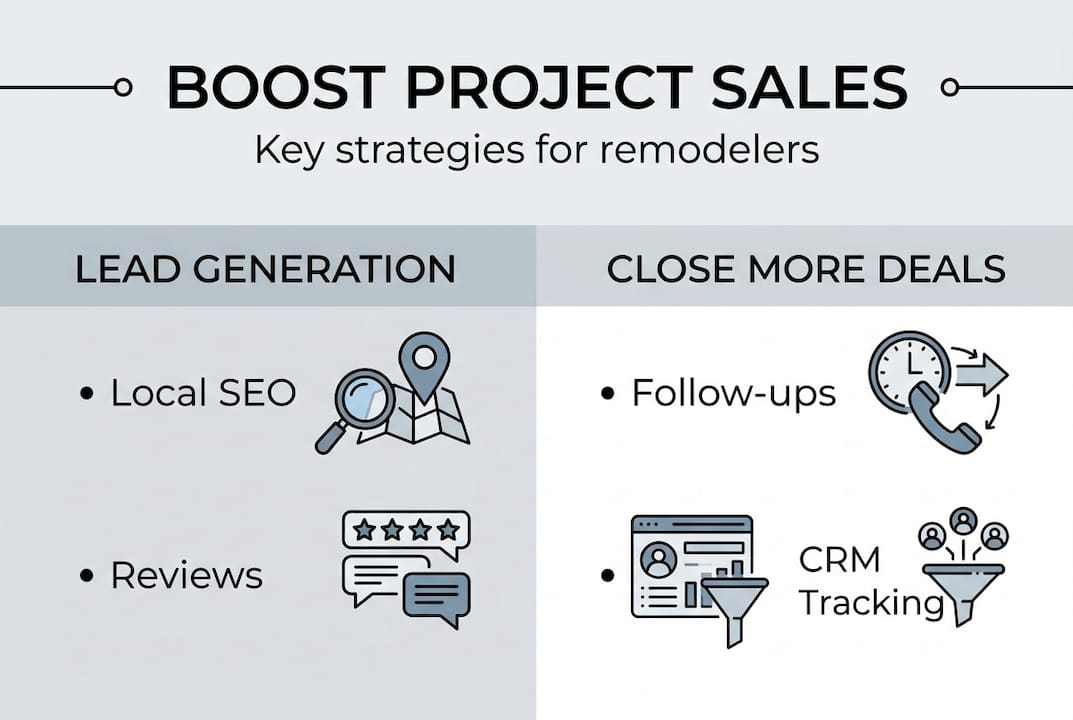
Benchmark your results against real industry data. A marketing ROI of 2x on closed projects is a solid baseline, with top performers reaching 100x in documented cases. With $603 billion spent on remodeling in 2024 and demand rising for kitchens and bathrooms, the market opportunity is real. Contractors who track and optimize are capturing a larger share of it.
Steps to optimize your sales system monthly:
- Pull your close rate, average job revenue, cost per lead, and follow-up frequency every 30 days
- Compare your numbers to the benchmarks in the table above and identify your single biggest gap
- Run one small test per month (a new follow-up script, a different ad headline, a revised proposal format)
- Re-engage your last 90 days of lost leads with a fresh outreach message
- Update your qualification questions based on patterns you see in closed versus lost deals
- Review your top 3 lead sources by close rate, not just by volume
Pro Tip: Re-marketing to past leads who said no is one of the fastest ways to generate new revenue. Circumstances change. A homeowner who passed in March may be ready to sign in September.
Grow your remodeling sales with expert help
Knowing the right strategies is one thing. Building and running the systems that execute them consistently is another challenge entirely. Most remodeling contractors are already stretched thin managing crews, clients, and projects. Adding a full sales and marketing operation on top of that is a real burden.
That is where a specialized partner makes a measurable difference. Shimmy Scaling works exclusively with home remodeling contractors to build AI-driven lead generation and appointment booking systems that run around the clock. Instead of chasing shared leads from marketplaces, you get pre-qualified prospects booked directly into your calendar. The result is less time on admin, more time on high-ticket projects, and a sales pipeline you can actually predict. If you are ready to stop guessing and start scaling, exploring a done-for-you system is a logical next step.
Frequently asked questions
What is the average close rate for home remodeling leads?
Most remodelers see a close rate between 15% and 30%, though rates climb significantly with structured follow-up and proper lead qualification. Seminar-based leads convert at 41%, which shows how much qualification method affects outcomes.
How many follow-ups are needed to close most remodeling sales?
It typically takes at least 5 follow-ups to close the majority of remodeling deals. 80% of sales require 5 or more touches, so stopping at 2 means leaving most of your pipeline on the table.
Are paid leads from marketplaces worth it?
Shared leads from marketplaces like Angi are highly competitive, meaning you are often one of several contractors bidding on the same prospect. They can work, but only with fast response times and a strong qualification filter.
What quick win can boost project sales immediately?
Charging for consultations is one of the fastest ways to improve close rates. Charged consultations filter out price shoppers and attract homeowners who are serious about moving forward, which makes every appointment more productive.